
Background #
Anaerobic digesters are a crucial element of biosolids processing in modern wastewater treatment facilities. Biosolids are valuable as organic material, with the caveat that they should fall under a threshold volatile solids content. Anaerobic digestion achieves this “volatile solids reduction” and produces renewable energy as a byproduct, making it very attractive for wastewater treatment plants. These plants primarily exist as a public service to uphold a sanitation standard, but this introduces a profit incentive.
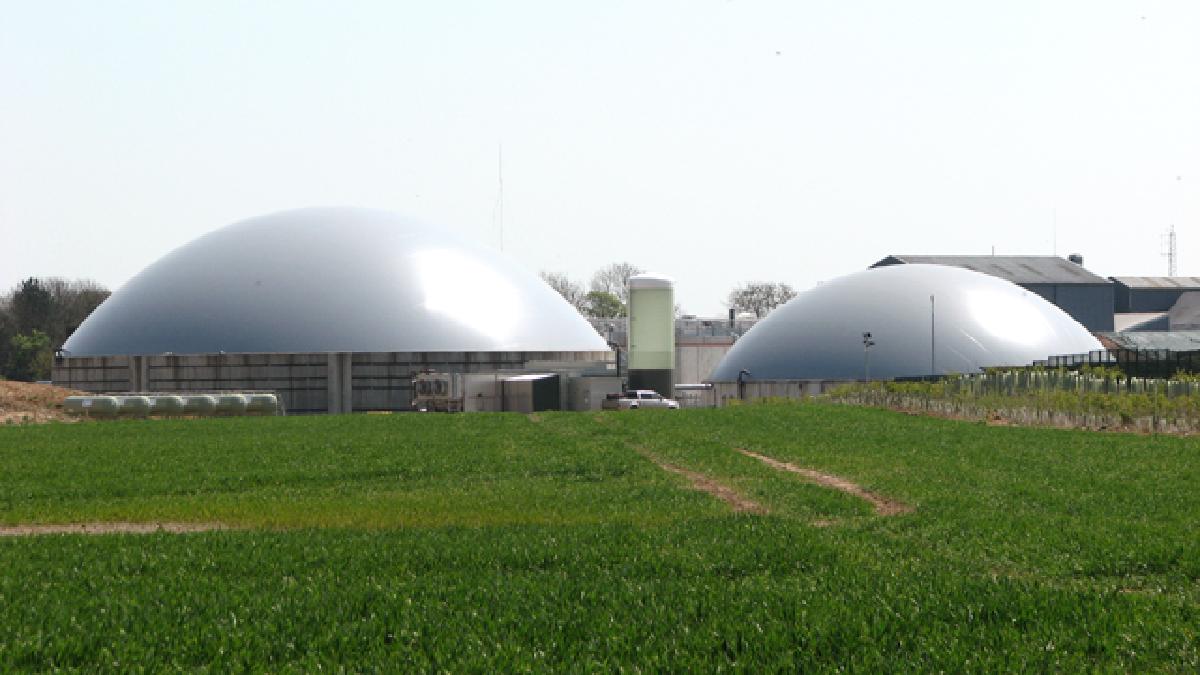
The biosolids processing section of a wastewater treatment facility starts with a preliminary separation of the wastewater feed by density followed by several processes which serve to reduce the liquid content of the biosolids stream, at this point it’s referred to as “sludge”. This stream is then fed into what is essentially a continuously-stirred tank reactor with a mix of micro-organisms inside which perform a multi-stage biological mechanism converting biodegradable organic matter into ultimately carbon-dioxide and methane gas. The tank is large enough such that the residence time is roughly in the order of ~2 weeks. To maintain anaerobic conditions the surface of the liquid is under a floating cover.
My Task #
Stantec was tasked with assisting with the design and startup of an anaerobic digester cluster that would be able to process the sludge from all of the wastewater treatment plants collectively in the area. When I was brought onto the team, they asked me to help specifically with projecting the feedrates to anaerobic digesters during the startup period.
Specifically, what this involves is taking a “seed” population of methanogens and trying to gradually ramp up the sludge feed such that in a 21-day rampup it will be able to handle a continuous feed of sludge at plant-scale operational flows. A crucial detail is that this is done by intermittently feeding sludge once a day to the “seed” reactors.
The Problem #
Anaerobic digestion is a biological process. Biological processes are dynamic and transient in nature. When the micro-organisms get “food”, they thrive and the population grows, as “food” grows scarce, the population decreases. However, it’s not this simple either. Too much food can lead to a population “shock” where the microbial population is imbalanced between different biological species, subsequently resulting in resource competition in the future that leads to sharp population decline. Additionally, the extent of the reaction (in industry, measured as the “volatile solids reduction”) depends on size of the microbial population as well as operational conditions.
Additionally, anaerobic digestion produces gas. This is a positive thing given the fact that the methane gas can be refined into renewable natural gas, however, from an operational standpoint, gas production can result in foaming under certain operating conditions. This can induce turbulance and result in reducing the lifespan of equipment.
Finally, due to the reduced water content of the sludge, it has the complex rheological properties of a non-newtonian fluid. For the most part this is a smaller concern, however there are situations where it becomes crucial such as in how it can produce overflow events during anaerobic digestion. See my explanation on how I determined the containment volume for an anaerobic digester overflow event for more details.
So, to translate the technical requirements of a solution to my problem, I need to be able to:
- Gradually increase the flowrate to the “seed” reactors each day such that by the end, the population is capable of handling the full process flow.
- Avoid any large deviations in the flowrate in order to not produce “shocks” to the population while still promoting growth.
- Model the volatile solids reduction of the process based on the projected change in microbial population to validate that gas production is within the appropriate operating range.
My Approach #
To ensure that I was able to get a solution which would be an accurate representation of the real world, there were a few key questions I needed to be able to answer:
- What is the safe margin for day-by-day increases to sludge feeds on an intermittent basis?
- What ratio of incoming solids to volatile solids reduction produces operational strain from foaming?
- How does the volatile solids reduction of a population evolve over time?
To do this, I collaborated with the lab to get experimental data. I understood that there were limitations to how well the data would encapsulate the much larger scale processes, but I would be collaborating to refine these over time as data comes in during the startup process.
A “safe margin” for an increase in the daily feed rate constitutes a percentage value which resulting in minimal variance in the volatile solids reduction value when fit to a sigmoid curve. What the “safe-margin” is really trying to enforce is a gradual population change which is sufficiently rapid but won’t induce “shock”. Because volatile solids reduction is largely tied to microbial population when operating conditions are regulated, it can essentially be used as a “population proxy” value. A sigmoid curve was used given the fact that it can approximate how population changes occur. Therefore, by fitting a model to the change in volatile solids reduction, the concern about how population evolves over time is addressed as well.
Foam generation is related to when the growth rate of acid-forming bacteria (responsible for the initial step of the biological process) outpaces the growth of methanogens (micro-organisms responsible for performing the final step). This assymetry results in the accumulation of chemical species which reduce surface tension and stabilize bubbles, preventing generated gas from escaping. This means by regulating the amount of solids being fed relative to the volatile solids reduction, foaming can be mitigated. Using the data from the lab, I obtained the design constraint.
After understanding the constraints of the solution and having a model for volatile solids reduction, I was ready to find a solution. What I needed to do what determine a way of solving sequential mass balances where the input from one day is dependent on the output of another and I could validate that the results met the design specifications at each step.
To do this, I opted for a combination of an Excel spreadsheet for mass-balance calculations and microbial growth modeling along with a VBA script to drive a “guess-and-check” algorithm that would iterate through flowrates until it found one that satisfied all constraints of the system each day. Given that the feed flowrate was limited in the extent that it could be granular (precision was limited to increments of 5,000 lbs/day), the logic for the VBA script did not need to be very complicated.
The Result #
The initial solution had some limitations. As I mentioned previously, the models I used for this solution were based on smaller scale lab testing which may not accurately encapsulate the dynamics of a plant-scale reactor. However, this “initial guess” was able to mitigate the majority of operational problems which was an improvement on previous iterations. Additionally, after a week, I was able to use the operational data to regress more accurate models to encapsulate the process, and after this point, nearly all operational problems related to foam generation were mitigated.
This was a very ambitious technical problem to have to solve so early in my career and I’m glad I was able to contribute something meaningful and overcome the obstacles presented before me. I also developed a fondness for biologically-driven reactions as a result of this which has taken me on a path to learn about protein manufacturing processes and enzymatic reactions. Ideally, in the future I can get an opportunity to creative solutions to other technical problems that similarly have a positive impact on real operation.